Loss of Development in Iranian Music

By Pouria Nasiri and Sadjad Pourghanad
The mention by music instructors, academicians, students, and music enthusiasts about the lack of development in Iranian music is a topic that has been repeatedly heard, resulting in a superficial understanding and misinterpretation of Iranian music, which has been conveyed to students of the arts. This short essay aims to critique and examine this claim.

Firstly, the term “Iranian music” or “music of Iran” must be defined, as it encompasses a wide range of music from different regions of Iran, classical Iranian music, Iranian pop music, and more. Since there is development and expansion in various areas of Iranian music, it is necessary to use the term “Iranian music repertoire” instead of a vague expression.

Secondly, there are numerous examples where the Iranian music repertoire has been utilized for music material extraction, followed by its development and expansion. For instance, we can mention compositions by Ahmad Pejman, Hossein Dehlavi, Kambiz Roshanravan, and Hossein Alizadeh.

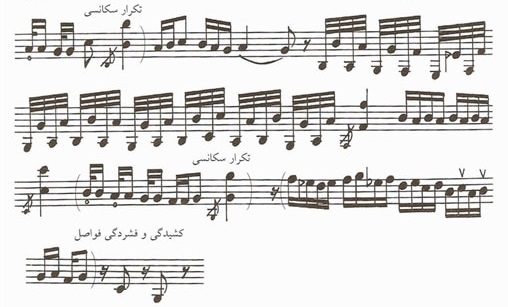
Thirdly, within the Iranian music repertoire (regardless of whether it is vocal or instrumental or told through a particular narrative), there exists a level of development and expansion in various aspects. One of the most important tools in this regard is the use of sequences, which plays a significant role in form and composition. Additionally, the extensive use of sequences in various modes such as Hesam, Khorasani, Khorshidi, Razavi, and Khavaran, among others, makes the claim of a lack of development and expansion in Iranian music unacceptable.

Furthermore, development and expansion are not solely achieved through sequencing but also through rhythmic, melodic, or rhythmic-melodic variations in the presented materials. For example, the introduction section (daramad) of Dashti vocal repertoire in the interpretation of Mirza Abdullah Boroumand showcases this. Moreover, the use of repetition (in literal, variational, or duplum forms) to strengthen the developmental process can be cited as a stage of expansion and development, countering the claims made.

Therefore, based on the aforementioned points, it is essential for music instructors and students to pay more attention to their interpretations of the position and characteristics of the Iranian music repertoire. By giving proper respect to this cultural and artistic foundation, they can make appropriate use of its capacities.
Post a Comment


Warning: Undefined variable $user_ID in C:\host-websites\harmonytalk.com\domains\en.harmonytalk.com\www\wp-content\themes\harmonytalk\comments.php on line 93
Required fields are marked *
*
*
Your email is never shared.

Parva, Iranian Singer, Passes Away!

Parva, a singer of Iranian music, has passed away after a period of illness. In recent years, she had been residing in both Iran and Austria.

Iraj Passes Away!

Iraj (Hossein Khajeh-Amiri), born on January 1, 1933, in Natanz, and one of the most renowned figures in Iranian vocal music, passed away at the age of 94 after several months of illness. He was born into an artistic and cultivated family; his ancestor was a celebrated singer during the era of Nasser al-Din Shah Qajar, and his father, who himself possessed a fine voice and was well-versed in the radifs (modal systems) of Persian music, devoted years to training his son’s voice. In his early youth, Iraj also participated in Ta’ziyeh (religious passion plays) and learned the subtleties of vocal performance step by step from Ta’ziyeh performers who had mastered the radifs and modes.

From Past Days…

Gholam Reza Khan Minbashian: a pioneer in Iranian music (II)

Gholamreza Khan Minbashian taught courses such as organology, orchestration of military music and harmony based on the books which were translated from French into Persian with the help of Aliakbar Mozayyan-o-Dolleh (1846-1932).

Hossein Aslani passed away!

Hossein Aslani, Iranian pianist residing in the US, passed away due to cancer in late January 2020. His last musical activity was an article written for Harmony Talk entitled “Iran amidst musical struggle” in 2016, his memoir entitled “I Play You Again” in the same year and his album “Symbolic Emotion” published by Arganoun Publications in 2014. Here is a brief biography of Hossein Aslani according to his own website:

Kayvan Mirhadi and O.R.P Qaurtet

Establishing O.R.P. Quartet is Kayvan Mirhadi’s latest activity as a guitarist, composer and conductor of Kamerata Orchestra. Besides working with this Quartet, Mirhadi is busy these days recording and mixing some of his own works as well as some pieces by 20th century composers. O.R.P Quartet performed a concert in Rasht, Gilan Province in late May 2016 and offered a master class.

Tehran Flute Choir Established

Tehran Flute Choir was established in 1394 (late 2015) by Firouzeh Navai. Tehran Flute Choir, Iran’s first largest flute choir, recruited its members mostly from young talented flutists of Iranian Flute Association. Featuring piccolo, flute, alto flute and bass flute, Tehran Flute Choir, directed by Firouzeh Navai, premiered under the batons of Saeed Taghadosi on January 7-8, 2016 at Roudaki Hall in Tehran.

HarmonyTalk Journal’s Twentieth Anniversary Celebration

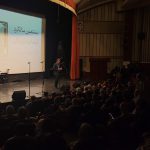
On the 10th of Khordad, 1403 (equivalent to May 30, 2024), the twentieth anniversary celebration of the online journal “HarmonyTalk” took place at the Ersbārān Cultural Center. The event garnered such interest from enthusiasts that the venue was completely filled.

Iannis Xenakis’ Persephassa

Shiraz Arts Festival which was held in Shiraz from 1967 to 1977 featured many contemporary renowned artists who were commissioned by the Iranian royalty to compose or create works of art for performance in the arts festival. Iannis Xenakis (1922-2001) participated in Shiraz Arts Festival three times in 1968, 1969 and 1971. The Greek-French composer,…
Read More »

HarmonyTalk Celebrates 11th Anniversary

April 6 marks the anniversary of launching HarmonyTalk.com. Back in 2004, HarmonyTalk was rather a blog dedicated to music. Gradually, however, it found its way to becoming a more sophisticated journal with an intensive but not exclusive concentration on classical music.

Qanun, a feminized instrument?

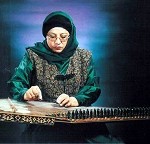
In the world music culture, there are instruments which were traditionally associated with a certain gender. It remains disputable to what extent these gender-based perceptions have been logical and scientific. For example, as playing wind instruments need more breath strength and the public opinion believe that men have stronger breath compared to women, these instruments are predominantly a male domain. Harp is also considered a female instrument as the public opinion believe that women have finer fingers and can therefore better perform nuances and delicate techniques on the instrument.

Prominent Iranian Musicologist Passes Away in Vienna

Khosrow Djafarzadeh, musicologist and architect, who was also one of the main authors of HarmonyTalk journal passed away on 15 July 2019.

Fereydoun Shahbazian, An Iranian Musical Icon Passed Away

Fereydoun Shahbazian, the renowned Iranian composer, passed away at the age of 82 due to respiratory illness in Tehran. His last significant activity was leading the National Orchestra before the appointment of Homayoun Rahimian.