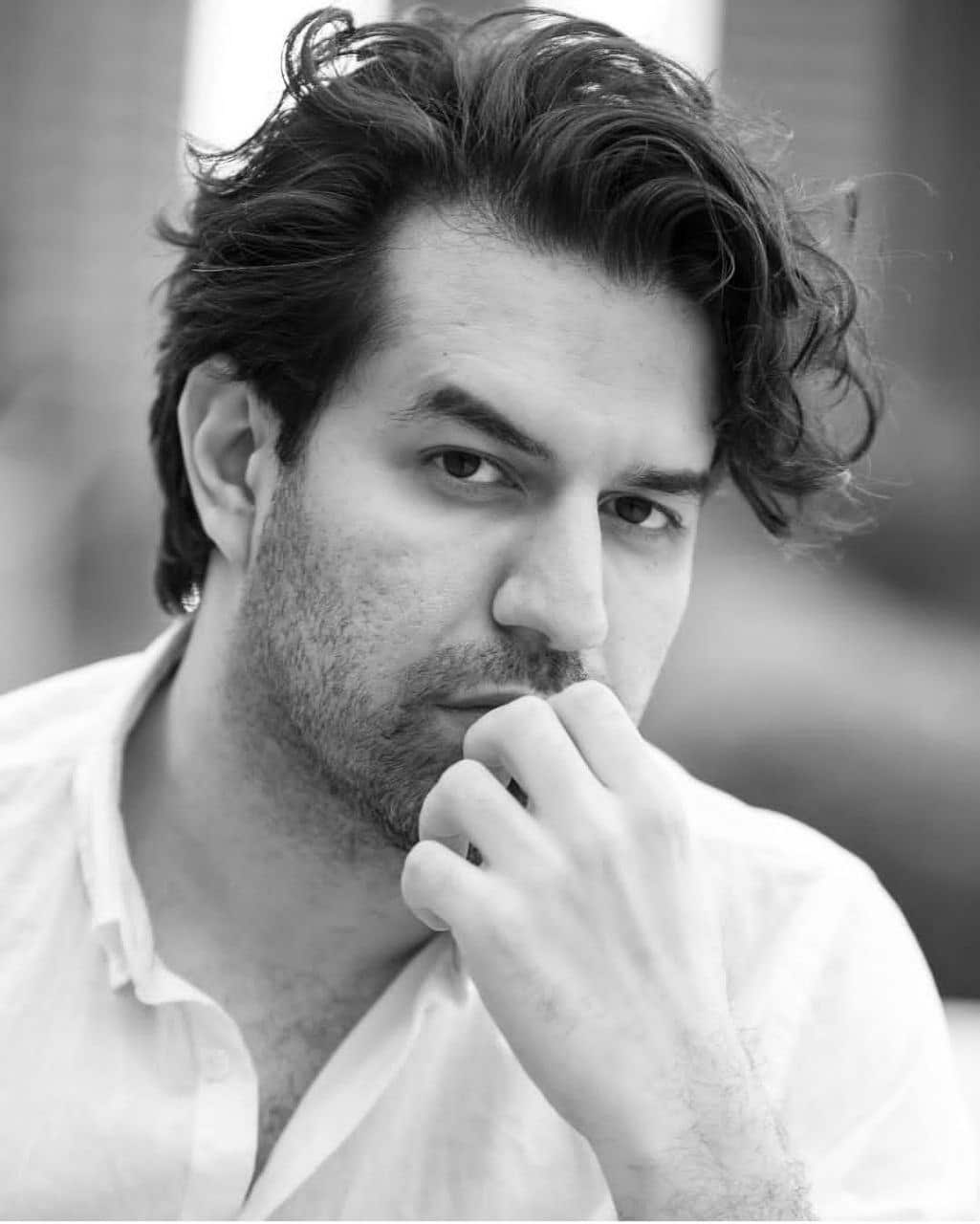
In an era when almost no trace of contemporary Iranian music can be heard in international concert halls, except (so-called!) avant-garde works that owe their existence solely to the fashionable slogans of the “pseudo-intellectual” crowd who have seized the already meager resources for performing classical music from the true artists of the field, the numerous performances of Farhad Poupel’s works shine as a ray of hope for lovers of sincere musical art. Without resorting to trendy slogans, he has kept the flame of Iranian classical music alive purely through the power of his artistry.
As Poupel himself says, driven first by a personal passion for ancient Iranian culture and then by a sense of duty in our present age to promote and introduce that culture, he has spent several years researching the ancient heritage of Iran, particularly its priceless literary treasure, Ferdowsi’s Shahnameh. In doing so, he has created several large-scale works that have, fortunately, succeeded, even “in these difficult times,” in establishing a firm foothold for themselves. Performed alongside the established masterpieces of Western classical music, they have reached the stages of Europe and America.
Despite the exalted status of Ferdowsi (the writer of Shahnameh), Iranian composers have rarely managed to draw upon his poetry in their works. In this writer’s view, three main reasons account for this:
1. The long narrative form of the Shahnameh stories: The Shahnameh is a chain of interconnected poems recounting extended epic tales; to set them to music requires composing in similarly large forms. Creating large-scale forms demands both deep knowledge of musical form and the ability to apply that knowledge in ways that keep the necessary developments and expansions dramatically engaging. A survey of Iranian composers’ works reveals a widespread lack of mastery in this area; only a small number, mostly those working in symphonic music, are truly equipped with this knowledge.
2. The distinctive and mysterious atmosphere of the Shahnameh: Its stories are filled with mythical, heroic, and enigmatic imagery quite unlike the lyrical and mystical themes that dominate most Persian poetry. Capturing such an atmosphere is extremely difficult using the tools of traditional Iranian dastgāh music, from its modes to its characteristic instruments. Consequently, we have very few successful Shahnameh-based works that rely on those resources. Moreover, even most Iranian symphonic composers approach orchestral writing with a dastgāh-oriented mindset, resulting in what we call the “nationalist” school. Setting Shahnameh texts and stories with such tools is not impossible only in the absolute sense, but it is extraordinarily challenging.
3. The particular meter of the Shahnameh’s poetry: One of the most frequently repeated complaints by Iranian composers is the challenge posed by the poem’s consistent, relatively simple meter throughout its 50,000+ couplets. Most Iranian composers approach the Shahnameh with the mindset of writing tasnifs within the “light classical” tradition, and they find this degree of departure from their habitual rhythmic world too daunting.
The most recent work by Farhad Poupel to be performed in Tehran was titled The
Laughter of Gordafarid. In this piece, he set to music one of the lesser-known
stories of the Shahnameh, in a style consistent with his earlier works on similar
themes.
In this work, he succeeded in recreating the story of Gordafarid for orchestra and
narrator in collaboration with renowned international writer William Nicholson
(screenwriter of Gladiator). In the performance by the Mithra Orchestra under
the direction of Mohammadreza Safavi, the text was translated into Farsi and
performed with the voice of Golab Adineh, a well-known artist of theatre and
cinema.
As in Poupel’s other works, The Laughter of Gordāfarid displayed his masterful
thematic development, vivid and ever-moving harmonic landscapes, skilful use of
twentieth-century techniques, and motivic figures that appeared precisely when
the drama demanded them, all combined with admirable intelligence and taste.
In the near future, this same work is scheduled to be performed at the prestigious
Kings Place in London.
Following the tradition of Iran’s most distinguished symphonic composers,
Farhad Poupel has, without relying on cliques, connections, or passing fads, once
again placed the name of Iranian composers on the international stage in a manner worthy of Iran’s heritage.
One can only hope that in the near future we will witness more performances and
recordings of his works and those of other gifted Iranian composers.
Etemad Newspaper (11.29.2025)