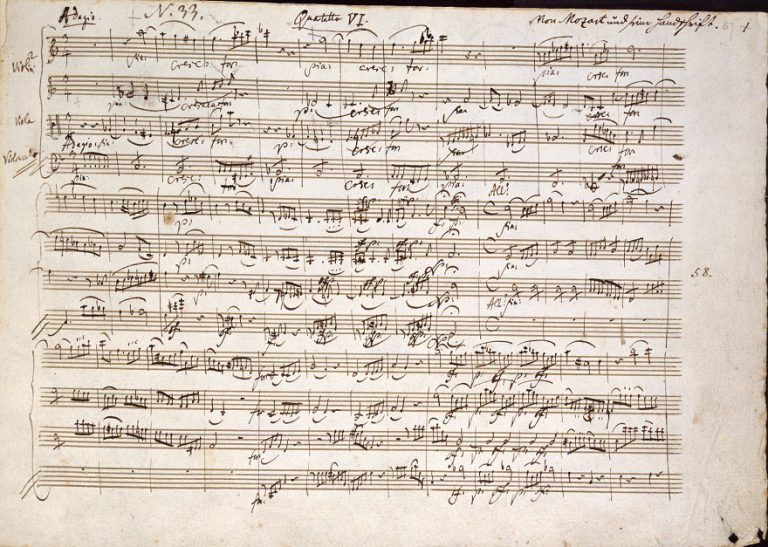
Lecture 5 & 6: Exploring Mozart’s K. 499 and Prussian Quartets
The late 18th century was marked by profound societal changes across Europe, characterized by the rise of the bourgeoisie and the reshaping of musical patronage. Composers like Mozart responded to these shifts by adapting their compositional styles to align with the tastes and sensibilities of the emerging middle class. This article seeks to explore this phenomenon through an analysis of Mozart’s K. 499 quartet, also known as the “Hoffmeister” quartet, and his Prussian quartets, alongside the works of his contemporaries. By examining the evolution of the string quartet genre within the context of changing social structures and aesthetic preferences, this study aims to shed light on the dynamic relationship between music and society.
Evolution of the String Quartet Genre
The string quartet genre underwent a remarkable evolution during the late 18th century, reflecting broader shifts in musical aesthetics, patronage, and societal structures. Emerging from its roots in the Baroque period as a form primarily associated with accompanying vocal music or serving functional roles in courtly settings, the string quartet gradually evolved into a sophisticated and independent genre of chamber music.
At the forefront of this evolution were composers like Franz Joseph Haydn and Wolfgang Amadeus Mozart, who played pivotal roles in establishing the string quartet as a quintessential form of musical expression. Haydn, often referred to as the “Father of the String Quartet,” made significant contributions to the genre through his extensive output of more than 80 string quartets. His works exemplified the Classical style with their balanced structures, thematic development, and inventive use of texture and timbre. Haydn’s quartets served as a foundation upon which subsequent composers would build, providing a model of excellence and innovation.
Mozart, while not as prolific in his output of string quartets as Haydn, made substantial contributions that showcased his mastery of the genre. Works such as his “Haydn” quartets, dedicated to his esteemed colleague, and the “Prussian” quartets composed towards the end of his life, demonstrate Mozart’s ability to infuse the string quartet with emotional depth, lyrical beauty, and contrapuntal complexity. Through his exploration of form and expression, Mozart expanded the boundaries of the genre, paving the way for future generations of composers.
In addition to Haydn and Mozart, other composers of the late 18th century made significant contributions to the evolution of the string quartet genre. Ignaz Pleyel, Franz Anton Hoffmeister, and Paul Wranitzky, among others, added their unique voices to the repertoire, each contributing to the richness and diversity of chamber music during this period. While these composers may not have achieved the same level of renown as Haydn or Mozart, their quartets reflected the stylistic trends and aesthetic preferences of the time, offering valuable insights into the cultural milieu of late 18th-century Europe.
The evolution of the string quartet genre was closely intertwined with broader socio-cultural changes occurring during the late 18th century. As the influence of the bourgeoisie grew and musical patronage shifted from aristocratic courts to private salons and public concert venues, the string quartet emerged as a symbol of cultural refinement and sophistication. Composers, eager to engage with this new audience, adapted their compositional styles to cater to the tastes and sensibilities of the emerging middle class, resulting in a flourishing of chamber music culture.
Overall, the evolution of the string quartet genre during the late 18th century reflects a period of innovation, experimentation, and artistic achievement. Composers like Haydn, Mozart, and their contemporaries pushed the boundaries of the genre, transforming it from a functional ensemble into a vehicle for profound musical expression. As we continue to explore the rich tapestry of Classical chamber music, it is essential to recognize the enduring legacy of these composers and their contributions to the evolution of Western musical culture.