Principles of Violin Playing (X)

Pattern 1.7
Portamento of left hand

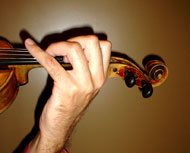
Creating sound continuity between two notes in the source and destination positions when left hand position changes and “two different finger numbers” are involved is called portamento. Portamento can be performed on single string or two neighboring strings and with hand moving on fingerboard either upward or downward.
7.1.1. when performing portamento involves moving left hand upward and changing finger from lower number to a higher one, (such as playing the note of G with third finger at fourth position after playing the note of B at first position with first finger of A string) this change must occur by shifting finger of lower number from source position to destination position, and placing finger of lower number on fingerboard quickly. (This example is performed by shifting first finger of E to first finger of B at fourth position and then quickly placing third finger of G at the same position).
7.1.2.when performing portamento involves moving left hand upward and changing finger from higher number to a lower one (such as playing note E with second finger at third position after plying note D with third finger at first position of A string) this change occurs by moving finger of higher number from source position to destination position and then quickly placing finger of lower number on fingerboard. (This example is performed by shifting third finger of D to third finger of F at third position and then quickly placing second finger of E at the same position).
7.1.3. when playing portamento involves moving left hand downward and with changing finger of higher number to finger of lower number (such as playing note A with first finger at first position after playing note C with second finger at second position on G string), this change should occur by shifting finger of higher number from source position to destination position and then quickly placing finger of lower number on fingerboard (this example is performed by shifting second finger of C to second finger of B at first position and then quickly placing first finger of A at the same position).
7.1.4. when playing portamento involves moving left hand downward with changing finger of lower number to finger of higher number (such as playing note C of second finger at first position after playing note D of first finger at third position on A string), this change should occur by shifting finger of lower number from source position to destination position and then quickly placing finger of higher number on fingerboard (this example is performed by shifting first finger of D to first finger of B to first position and then quickly placing second finger of C on the same position).
7.1.5. The general rules of portamento when occurring between two neighboring strings don’t differ from those of portamento occurring on a single string.
Notification 22: during practice, playing portamento begins with heavy tempo and the note of the shifting finger is played like a Ornament.


Post a Comment

Required fields are marked *
*
*
Your email is never shared.

Farhad Poupel: The Voice of the Shahnameh in the Orchestras Around the World

In an era when almost no trace of contemporary Iranian music can be heard in international concert halls, except (so-called!) avant-garde works that owe their existence solely to the fashionable slogans of the “pseudo-intellectual” crowd who have seized the already meager resources for performing classical music from the true artists of the field, the numerous performances of Farhad Poupel’s works shine as a ray of hope for lovers of sincere musical art. Without resorting to trendy slogans, he has kept the flame of Iranian classical music alive purely through the power of his artistry.

Five Major Myths About Mozart’s Life

Wolfgang Amadeus Mozart, the renowned Austrian composer, is undoubtedly one of the greatest geniuses in the history of classical music. However, his life is surrounded by numerous myths and legends, some of which are not based on facts. This article explores five of the most common misconceptions about Mozart’s life.

From Past Days…

Homayoun Rahimian & Iran’s National Orchestra

The Roudaki Foundation presented the permanent conductor of the National Orchestra (Orchestr Melli), Homayoun Rahimian, in a ceremony, and finally, after four years, the national orchestra found a permanent conductor. Homayoun Rahimian is the fourth permanent conductor of this orchestra after Farhad Fakhreddini, Bardia Kiaras, and Fereidoun Shahbaziyan. He, who has previously had experience of conducting concerts besides being Meister’s concert of this orchestra, performed the concert “Autumns” on the 20th of Tir, performing works by Rouhollah Khaleqi, Javad Ma’roufi, and Hossein Dehlavi.

HarmonyTalk Celebrates 11th Anniversary

April 6 marks the anniversary of launching HarmonyTalk.com. Back in 2004, HarmonyTalk was rather a blog dedicated to music. Gradually, however, it found its way to becoming a more sophisticated journal with an intensive but not exclusive concentration on classical music.

A Note on the Occasion of Houshang Zarif’s Demise

No introduction is needed when talking about the position of the late Houshang Zarif (1938-2020) in the Iranian music. His character and personality are so well-known among musicians that his name per se is a symbol and role model for the Iranian youth. “Becoming Houshang Zarif” is the dream of many young people who enter the world of music in Iran and many of whom retire regretting the realisation of this dream.

Polyphony in Iranian Music (I)

Despite the fact that Iranian folk music (regional music of Iran), like the Radif of Iranian traditional music, is monophonic and follows heterophony in principal, we experience polyphonic forms, albeit, majorly unconscious.

The Structure of Kurdistan Daf (VI)

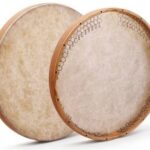
Researcher: Mohammad Tarighat Translator: Fatemeh Alimohammadi Hooks and attached rings: The junction of the ring to the arch is about 3 centimeters from the skin.  The ring with its side rings should be as far as the diameter of a ring (about one and a half to one and eight centimeters) to make a proper…
Read More »

Interview with the Makers of the New Qeychak (I)

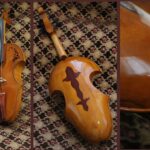
On occasion of the 8th anniversary of launching HarmonyTalk Online Journal on 6 April 2012, Reza Ziaei, master luthier and researcher on classical music instruments (violin family), announced that the first phase of the project to improve Qeychak has borne fruit. The new instrument would feature a bowl of ribs and the material used for the surface would be wooden. Carrying out the second phase of the project took more than 7 years engaging the new members of Reza Ziaei’s Workshop. In this phase, new researches were conducted from different aspects on the Qeychak and the modern versions of the instrument which were introduced previously by other instrument makers. The available versions of the instrument were studied in terms of their weak and strong technical features.

Polyphony in Iranian Music (II)

With regard to each polyphonic form, only one specific and distinguished example is analyzed. These polyphonic forms are as follows:

A note on “Illusion or Ingenuity” article

The author of the “Illusion or Ingenuity” article, who is apprehensive of the future of the Music in Iran, enumerates some symptoms of the music weakening in the country for example decreasing in the quality of the music as well as lack of the innovation in creating them, a gradual decline in the music public taste and the drop in the application of layered sound and polyphony in music. He explains that one reason for this gradual weakening might be our unawareness of the fact that we are not so intelligent nation. He believes that we, Iranians, have a comprehensive “Illusion of the high national intelligence “that make us ignorant of the unfavorable realities of our music and consequently no searching for the remedy is taking place. His point of view brings to the mind a patient who thinks he is healthy, therefore delays the treatment and finally is killed by the disease. The author also refers to the national difficulties which gradually will lower the national intelligence score such as the increased rate of the immigration and brain drain, low quality of the nutrition, incompetence of the education system and etc and predicts that the condition of the music of Iran might deteriorate in the future because of the mentioned illusion of its great status.

A Promising Concert by National Instruments Orchestra

The National Instruments Orchestra of Iran performed its first concert amid much hope and anxiety on July 18, 2015. The Orchestra is founded by Roudaki Cultural and Arts Foundation which is a semi-private foundation in Iran. The Arts Director for the National Instruments Orchestra of Iran is cand the Orchestra Executive Director is Sadjad Pourghand.

A Persian Nocturne for Piano

A Night in a Persian Garden is the name of a Nocturne composed by the Persian (Iranian) contemporary composer Behzad Ranjbaran. This Nocturne, published recently by the Theodore Presser Company in the US, was performed for the first time in 2002 in New York City by the young Persian pianist Soheil Nasseri and has enjoyed many performances by other pianists.