Iraj (Hossein Khajeh-Amiri), born on January 1, 1933, in Natanz, and one of the most renowned figures in Iranian vocal music, passed away at the age of 94 after several months of illness. He was born into an artistic and cultivated family; his ancestor was a celebrated singer during the era of Nasser al-Din Shah Qajar, and his father, who himself possessed a fine voice and was well-versed in the radifs (modal systems) of Persian music, devoted years to training his son’s voice. In his early youth, Iraj also participated in Ta’ziyeh (religious passion plays) and learned the subtleties of vocal performance step by step from Ta’ziyeh performers who had mastered the radifs and modes.
Tag Archives: iraj
Latest posts
- Parva, Iranian Singer, Passes Away!
- Iraj Passes Away!
- Sohrab Pournazeri Becomes a Member of the GRAMMY Academy
- Shapour Rahimi Passes Away
- ShirMohammad Espandar Passes Away
- Jamshid Chemirani Passes Away
- Book “Iranian modal system (Dastgah music) modes” Published
- Transition to Enlightenment: Six Lectures on Mozart’s String Quartets (5)
- Nasser Masoudi: The Voice of Gilan and a Legacy of Iranian Music
- Farhad Poupel: The Voice of the Shahnameh in the Orchestras Around the World
- Five Major Myths About Mozart’s Life
- Bahma Rajabi Passed Away!
From Past Days…
Ahmad Pejman Passed Away!
Composer and music teacher Ahmad Pejman (1935–2025) passed away on August 29 in Los Angeles, USA, after several weeks of illness. His most recent symphonic work performed in Iran was Land of the Brave (“Sarzameen-e Delavaran”), which was staged in 2017 with the Tehran Symphony Orchestra. According to the family’s decision, his body will be laid to rest in the United States.
Interview with the Makers of the New Qeychak (III)
In this project, my specialized responsibility was the basic drawings of the desired instrument with the help of engineering and mechanical software. I have also the carried out phases related to engineering designs, related variables, and volume and weight calculations under Mr. Ziaei’s direct supervision from the very beginning. Regarding the challenges of this work, suffice it to say that the set of designs for the instrument lasted more than 9 months in the final stage of the project only.
Principles of Violin Playing (IX)
4.3.1. To practice playing of doubles of notes involving two different fingers, each note is played at separate bows with slow tempo, each note is played perfectly regarding its bass and tenor sounds and then the considered double is played at another bow while considering the resulted sound of the double.
Principles of Violin Playing (VIII)
1.5.1.3.sometimes, a player, due to different reasons, may decisively want to play continuously two notes with a half-step by means of the same finger, in such a case, it’s necessary to open the interior curve of the finger like a spring. Naturally coming back, the curve of finger should be closed and the finger should become curved shape again (see paragraph 3.1.2.1).
Jamshid Andalibi passed away!
Jamshid Andalibi, one of the most famous ney players in Iran, passed away on the fifteenth of Esfand, 1402, at the age of 66 due to a heart attack at his private residence. Andalibi was a member of a family that had a significant presence in the field of Iranian music in the sixties and…
Read More
Violin’s inner mold, an essential factor in developing the idea of violin
A part of the secrets of the masterpieces from the golden era lies in the special design of the instruments, as a result of a profound insight to and awareness of the significance of the precise calculation of the various components of the object of arts being created, such as making a violin or a bow.

Principles of Violin Playing (VII)
4.3.1.3 Regarding the great linear distance and the unusual distance between the first and forth fingers, the first finger while playing the doubles of ninth and tenth interval, can be twisted in the knuckle area and the point mentioned in 3.1.2.5 paragraph in relation to the way first finger is placed indicating that the first joint of this finger in back of hand must be in line with the direction of forearm and left hand is not true here.
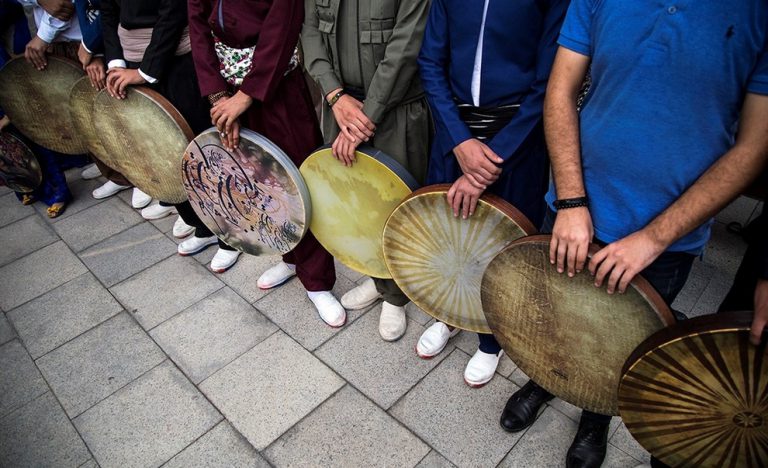
From Tradition to Trend: The Evolution of Decorative Arts in Iranian Dafs
Daf is one of the percussion instruments associated with the Kurdistan region of Iran, which has a special place in Iranian music. In the past, animal skin was used for the drum head, but now most of the tambourines in the market are made with artificial skin, which are designed with various decorations.
Rare documents of Tehran Opera Company published in Europe
The year 2020 marks the 10th anniversary of Evlin Baghcheban’s death. She played a crucial role to promote opera and choral music in Persia (Iran). Born to an Assyrian-French family in Turkey, she studied singing and piano at the Ankara State Conservatory. In 1950 Evlin married the Persian composer and fellow student Samin Baghcheban and moved to Tehran.
Quality Decline in Regional Music Festivals
Regional music festivals are organized to, firstly, introduce the music of different regions and, secondly, to support its performers. Regional music festivals are held in large cities for various reasons, including the availability of financial and executive facilities and the presence of an audience. However, the organization of these festivals has always been one of the challenging issues of ethnomusicology. The reason is that the presence of regional music performers in large cities places them in a context other than the context they would normally perform in their homes; consequently this change in situation leads to changes in the quality of their performance.