Davoud Pirnia, writer and musicologist was the founder of “Golha” (Flowers of Persian Song and Music) programs on Tehran Radio (1956-1966). He received his early education from his father, Hassan Pirnia (Moshir al-Douleh), and several tutors of the time (Taraghi, interview, July 1989) and continued his studies at Saint Louis School in Tehran and then in Switzerland and graduated in law. While studying law, Pirnia got acquainted with European classical music. Upon returning to Iran, he was employed by the Ministry of Justice and founded the Lawyers’ Guild. Then he was transferred to the Ministry of Finance and established the Department of Statistics in this ministry. Later, he became the head of the state inspection office at the Prime Ministry; he was, then, promoted to the position of the Deputy Prime Minister (Navab Safa, interview, August 1999)
Tag Archives: Censorship in Music
Latest posts
- Parva, Iranian Singer, Passes Away!
- Iraj Passes Away!
- Sohrab Pournazeri Becomes a Member of the GRAMMY Academy
- Shapour Rahimi Passes Away
- ShirMohammad Espandar Passes Away
- Jamshid Chemirani Passes Away
- Book “Iranian modal system (Dastgah music) modes” Published
- Transition to Enlightenment: Six Lectures on Mozart’s String Quartets (5)
- Nasser Masoudi: The Voice of Gilan and a Legacy of Iranian Music
- Farhad Poupel: The Voice of the Shahnameh in the Orchestras Around the World
- Five Major Myths About Mozart’s Life
- Bahma Rajabi Passed Away!
From Past Days…

Hossein Aslani passed away!
Hossein Aslani, Iranian pianist residing in the US, passed away due to cancer in late January 2020. His last musical activity was an article written for Harmony Talk entitled “Iran amidst musical struggle” in 2016, his memoir entitled “I Play You Again” in the same year and his album “Symbolic Emotion” published by Arganoun Publications in 2014. Here is a brief biography of Hossein Aslani according to his own website:

Five Major Myths About Mozart’s Life
Wolfgang Amadeus Mozart, the renowned Austrian composer, is undoubtedly one of the greatest geniuses in the history of classical music. However, his life is surrounded by numerous myths and legends, some of which are not based on facts. This article explores five of the most common misconceptions about Mozart’s life.

Last Year under the Light of Music
Almost three months into the new Iranian year (starting March 21), it is still not too late to have a look at the last year and the challenges that the musicians faced. The following article was published on the first day of the New Year in the Persian edition of the HarmonyTalk journal.

Farshad Sanjari, Forgotten Iranian Conductor Met His Tragic End
Farshad Sanjari, one of the most renowned Iranian conductors in the 1970s in Iran died after fire broke in his apartment in Vienna on November 22, 2019. Farshad Sanjari was not involved in politics; however, he was one of the victims of the Iranian Islamic Revolution in 1979. After the victory of the Islamic Revolution, his name was never seen as the conductor of any programmes.

Henry Cowell: “Persian Set”
Persian Set: Four Movements for chamber orchestra: Moderato; Allegretto; Lento; Rondo
Henry Cowell, one of the most innovative American composers of the 20th century, was born in 1897. Cowell and his wife visited Iran in 1956 and stayed there the whole winter, upon the invitation by the Iranian Royal Family, when he composed his album “Persian Set” in four movements for chamber orchestra. His composition is expressive of the characteristic quality of the Persian or the Iranian music.
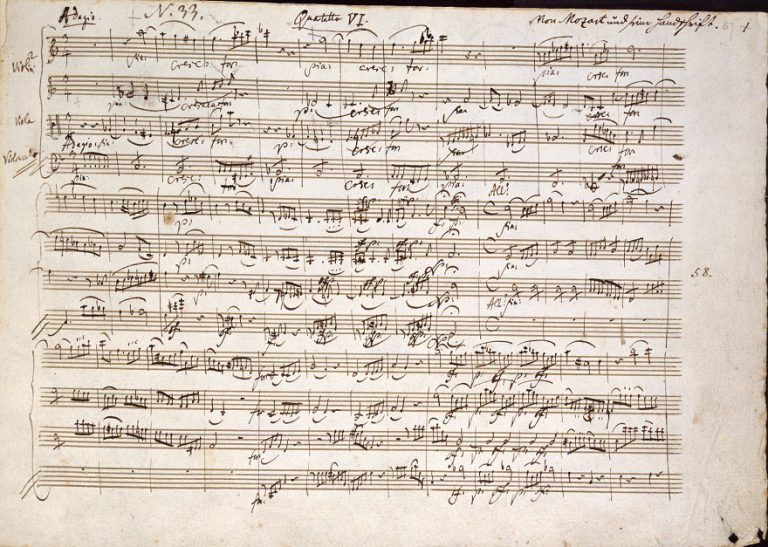
Transition to Enlightenment: Six Lectures on Mozart’s String Quartets (4)
The collaboration between Mozart and Haydn blossomed during the late 18th century in Vienna, a city that served as the epicenter of musical innovation. Amidst this vibrant cultural milieu, the two composers developed a profound friendship that extended beyond mere professional admiration. This connection is reflected in the six string quartets dedicated by Mozart to Haydn, aptly known as the “Haydn Quartets.”

Loss of Development in Iranian Music
The mention by music instructors, academicians, students, and music enthusiasts about the lack of development in Iranian music is a topic that has been repeatedly heard, resulting in a superficial understanding and misinterpretation of Iranian music, which has been conveyed to students of the arts. This short essay aims to critique and examine this claim.

Quality Decline in Regional Music Festivals
Regional music festivals are organized to, firstly, introduce the music of different regions and, secondly, to support its performers. Regional music festivals are held in large cities for various reasons, including the availability of financial and executive facilities and the presence of an audience. However, the organization of these festivals has always been one of the challenging issues of ethnomusicology. The reason is that the presence of regional music performers in large cities places them in a context other than the context they would normally perform in their homes; consequently this change in situation leads to changes in the quality of their performance.

Principles of Violin Playing (VIII)
1.5.1.3.sometimes, a player, due to different reasons, may decisively want to play continuously two notes with a half-step by means of the same finger, in such a case, it’s necessary to open the interior curve of the finger like a spring. Naturally coming back, the curve of finger should be closed and the finger should become curved shape again (see paragraph 3.1.2.1).

Women Musicians in Large Iranian Orchestras
It is more than a century now that the sociologists consider the presence of women in different social domains as a benchmark for a society’s progress. They analyze the presence of women in society by the means of available statistics. Unfortunately, as with regard to the Iranian society, statistics related to women’s engagement, has not been available to the researchers, if they existed at all.