The Structure of Kurdistan Daf (VII)

Researcher:
Mohammad Tarighat

Translator:
Fatemeh Alimohammadi


Conclusion

“Daf” is one of type of percussion instruments that has a long history and is commonly known as circular instruments (with a rim). In some tribes, Daf was used as the main instrument in festivity and joy ceremonies; in another tribe it was used as the main instrument for war and campaign ceremonies and some others used it for ritual and religious ceremonies.

In Iran, there are many different names for circular instruments such as: Daf, Dayereh, Charkh, Gharbal, Deire, Ghaval, Dap, Doyah, Sama, Daryeh, Buter, Doub, Taborak and so on.

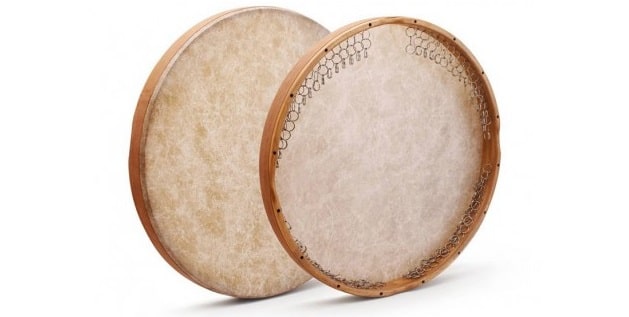
In this article, a circular instrument called “Daf” in Kurdistan was studied that its components include:

Arch, frame, Gharbali: The type of wood used in Daf depends on the variety of trees in the area. In this instrument, woods of grape, orange, fig, walnut, maple, berry, quince, plane tree, ash (Van, Benav, Benavch) and Salicaceae such as: poplar and red willow are used.

The piece of wood, about two meters long, is made in a circle shape with a diameter between 53 and 55 centimeters. Dimensions will be different for children and youth and a diameter of less than 50 cm is considered for them. In some cases, the diameter may be more than 55 cm , which is made only for the type of sounding  in an orchestra. The thickness of the arch wood in the part where the studs are located is about one and a half centimeters. The Avazeh of Daf also starts from the middle of the frame and gradually decreases to a thickness of two and a half to three millimeters at the junction of the skin. The width of the frame is between five and seven and rarely 10 cm (these are known as monastery Daf), it is preferably compared to the size of the player’s palm, so that the knuckle of the thumb does not bend. Such a width will also prevent the wrist from bending in the “middle” beat.

Thumb index: The location of the thumb to hold the Daf. The size of the thumb should be appropriate with the size of the player’s palm and the length of his fingers so that the wrist does not bend during the “middle” beat.

Today, hooks and rings, unlike the past that were made of brass, steel or copper, are only made of iron. The rings are made of iron wire about one and a half to one and eight centimeters in diameter and about one millimeter thick. The distance between the hooks and the skin is calculated by taking into account half the width of the arch and adding about half a centimeter from the skin. The distance between the ring and the side rings should be as large as the diameter of a ring, which makes for a better arrangement and less interference of the rings and a clearer sound, and also helps to keep the instrument lighter. In each hook, there are four rings that the first and second rings are connected from above as a single and the next two rings are connected to the second rings in pairs.

Skin: Old, fat-free, clear, and transparent skin of animals such as sheep, goat, yeanling, lamb, ewe, antelope, fish, camels, calve, and deer, but today sheep skin and in some cases goat skins are used.

Studs or tacks made of brass, copper or iron are used to attach natural skin to arch.

Strap: When the duration of playing Daf is long, a strap is installed on the inner edge of the Daf, which the musician wraps around his wrist to reduce hand fatigue.

The best weight for Daf is a weight that applies a slight pressure to the forearm muscles. In simple terms, the musicians feel the weight of instrument.

It is hoped that this article has led Daf learners to take a deeper look at the form and components of this ancient instrument than before, and that the art of making Daf, especially Dafs with artificial skin, will be revived by using veterans’ experiences, having no weaknesses and shortcomings in the structure.  Another important issue that needs basic research is the study of the relation between the weight and diameter of the arch of Daf with limbs, ossification and muscle mass at different ages of Daf musicians, which can be divided into different groups and as a result, design and construction of instruments in various dimensions in accordance with medical science standards and without possible damage to Daf players.


Resources

  • Ahmadi, A., 2019, Daf officials, New Note Publications, Yazd, First edition.
  • Pahlavan, K., 2015, Daf and Dayereh, Arun Publications, Tehran, First edition.
  • Tohidi, A., 1998, Daf playing style, Soroush Publications, Tehran, First edition.
  • Khaktinat, A., 2005, Daf and playing Daf, Sureh Mehr Publications, Tehran, First edition.
  • Darwish, M.R, 2005, Encyclopedia of Iran Instruments, Mahour Cultural and Artistic Institute, Tehran, Volume 2, First Edition.
  • Mohammadi, B., 2001, Daf and its feasts in Ghaderi’s Takaya, Mahidasht Publications, Kermanshah, First edition.
  • Moradi, A., 2020, Daf in monastery, Arshadan Educational and authoring Institute, Tehran, Volume One, First Edition.
  • Mogharab Samadi, A., 2009, Exercise of Love, First book, Tasnif Publishing, Tehran, First edition.
  • Nasrollahpour, A., 2000, Kurdish instruments, Taghbostan Publications, Kermanshah, First edition.
  • Naqib Sardasht, B., 2007, Knowing instrument in Kurdish music, Tavakoli Publications, Tehran, First Edition.


Researcher’s Interviews

  • Jabari, A., 2022, About pathology of Daf players, May, In person interview, Tehran.
  • Hosseini, B., 2021 and 2020, About his Daf playing Style, September and January, In person interview, Sanandaj.
  • Mohammadi, H., 2021, About the structure of Daf, September, In person interview, Sanandaj.

Post a Comment

Required fields are marked *
*
*
Your email is never shared.

Farhad Poupel: The Voice of the Shahnameh in the Orchestras Around the World

In an era when almost no trace of contemporary Iranian music can be heard in international concert halls, except (so-called!) avant-garde works that owe their existence solely to the fashionable slogans of the “pseudo-intellectual” crowd who have seized the already meager resources for performing classical music from the true artists of the field, the numerous performances of Farhad Poupel’s works shine as a ray of hope for lovers of sincere musical art. Without resorting to trendy slogans, he has kept the flame of Iranian classical music alive purely through the power of his artistry.

Five Major Myths About Mozart’s Life

Wolfgang Amadeus Mozart, the renowned Austrian composer, is undoubtedly one of the greatest geniuses in the history of classical music. However, his life is surrounded by numerous myths and legends, some of which are not based on facts. This article explores five of the most common misconceptions about Mozart’s life.

From Past Days…

A Miracle in the Iranian Music: About Tehran Flute Choir’s Eight-year Tenacity

Tehran Flute Choir is a 40-member orchestra of Iran’s best flutists; Iran’s best flutists? Yes! If you write down the names of the greatest Iranian flute players who participate at concerts and contribute to academic centers in Iran, you will see that most of them are among the choir’s members.

Inefficiency of some chords and harmonization systems in Iranian music

Discussions and research have been conducted on the harmonization of “dastgah” and melodies in Iranian music, and several books have been published on this topic, including “Armenian Music of Iran” by Ali Naghi Vaziri, “Harmony of Iranian Music” by Farhad Fakhreddini, and “Harmony of Iranian Music” by Ali Ghamssari. A master’s thesis titled “Presenting a Solution for Harmonizing Based on the Structure of Tritone Intervals” was written by Atefeh EinAli in 2014. Additionally, the invention and use of “Even Harmony” by Morteza Hannaneh should be mentioned.

Motherland Orchestra Broke the Spell of the Covid-19 Restrictions

The Motherland Orchestra staged the first concert since the outbreak of the pandemic under the baton of Nezhat Amiri. The orchestra went on stage on December 23-24, 2021 in memory of Rouhollah Khaleghi and Golnoush Khaleghi at Vahdat Hall, Tehran, Iran. Since the pandemic outbreak, concerts were held online and restrictions were imposed on in-person concerts.

Hossein Aslani passed away!

Hossein Aslani, Iranian pianist residing in the US, passed away due to cancer in late January 2020. His last musical activity was an article written for Harmony Talk entitled “Iran amidst musical struggle” in 2016, his memoir entitled “I Play You Again” in the same year and his album “Symbolic Emotion” published by Arganoun Publications in 2014. Here is a brief biography of Hossein Aslani according to his own website:

Mohammad Esmaili passes away

Master Mohammad Ismaili, a prominent musician and renowned tombak player, passed away on August 13, 2023, after battling an illness in the ICU of Rasoul Akram Hospital. His funeral will take place on Thursday, August 17, at 10 am in front of Vahdat Hall, and he will be laid to rest in the Artists’ Section of Behesht Zahra Cemetery.

Interview with Farhad Poupel (II)

Fantasia on One Note was my first professional work for piano, which had its world premiere by the great pianist Peter Jablonski in Sweden, and it has been performed by various pianists in the UK, Germany, France, and the Czech Republic. The recording of this work has also been broadcast on the Dutch public radio, NPR Radio 4.

Parviz Meshkatian’s Heart Beat for People (I)

Amidst the popularity of traditionalism in the Iranian music, Parviz Meshkatian (1955- 2009) moved from Neyshabur to Tehran. He learnt to play Santour and became educated in the Radif of Iranian music at the Centre for Preservation and Promotion of Music which was at the forefront of promoting the return to musical traditions. Despite his studies at a centre which promoted the use of the phrase “traditional music” in Iran, Parviz Meshkatian emerged as a creative artist whose innovative and unique ideas attracted the admiration of Iranian artists and people from different walks of life. This article studies the reason behind Meshkatian’s deviation from the wrong approach of traditionalism strongly promoted by the Centre and argues that apart from the issue of theory of Iranian music, he can be considered as Ali Naqi Vaziri’s successor.

Iranian Fallacies – Composition and Arrangement

In the tradition of classical music, it is generally tried to use the same technical terms related to music in all countries. Even in the cultures in which native terms exist to refer to musical terms, usually the better known universal terms are employed.

Kayvan Mirhadi and O.R.P Qaurtet

Establishing O.R.P. Quartet is Kayvan Mirhadi’s latest activity as a guitarist, composer and conductor of Kamerata Orchestra. Besides working with this Quartet, Mirhadi is busy these days recording and mixing some of his own works as well as some pieces by 20th century composers. O.R.P Quartet performed a concert in Rasht, Gilan Province in late May 2016 and offered a master class.

Shaahin Mohajeri Wins UnTwelve Composition Competition

UnTwelve Non-profit Organization announced the results of its 2014/2015 composition competition on January 28, 2015. Shaahin Mohajeri, an Iranian Tonbak player, microtonalist, acoustician and composer, was awarded the second prize for his piece “Castle of Babak.”