“I Will Never Perform Just for Women!”: Golnoush Khaleghi Passes Away in Exile

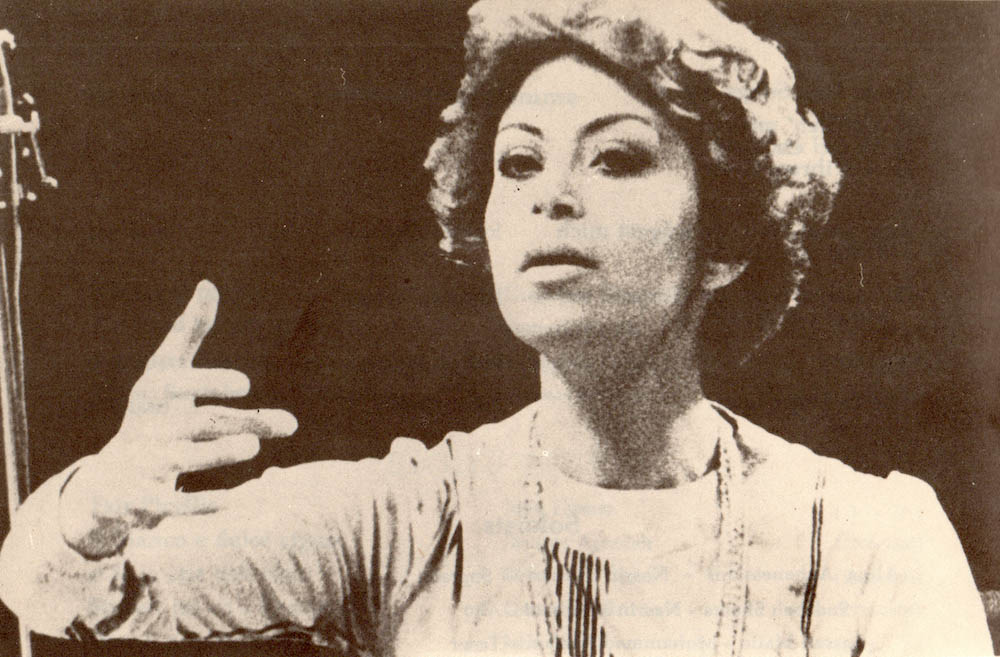
Golnoush Khaleghi, first Persian woman conductor and daughter of legendary composer Rouhollah Khaleghi, passed away on February 14. She was 80.

Golnoush Khaleghi was the conductor of the NIRT (National Iranian Radio & Television) Choir in the 1970s. Shortly after the 1979 Islamic Revolution Ms. Khaleghi moved to the United States and founded the Rouhollah Khaleghi Orchestra in Washington DC to preserve Persian music. BBC’s Pejman Akbarzadeh has reviewed her career.
The year 1974 was the beginning of Golnoush Khaleghi’s professional career. She was invited to Persia to establish the National Radio and Television’s choir, known as ‘Hamavazan’. This choral group performed various concerts focused on Western classical music.
“The Television at that time had a quite successful chamber orchestra which was formed some years earlier. They were going to expand the activities of this orchestra and have a professional choral group to collaborate with it. Therefore, when I suggested to establish a choral group, the Television warmly received the idea.” Golnoush Khaleghi said in a 2016 interview.

The choral group’s career expanded a lot but the victory of the Islamic Revolution halted its activities. The last work of this choir was the secretive recording of Azadi [Freedom] anthem by Golnoush Khaleghi with lyrics by Fereydoun Moshiri.

Golnoush Khaleghi in the same interview said: “One day that I was heading to the Television the chief sound engineer said to me ” I’ve heard that you have written a beautiful anthem!” The choir members had told him. He asked me “Are you not willing to record this work?” I replied: “I would love to record it but don’t know if I am allowed to record that.” He said: “No, they will not allow you to record this piece but we will do it secretly!” – The chief sound engineer was Yousef Shahab. He said “I will provide you a studio but if the Revolutionary Guard finds out about that, they will not allow you to record. So, you can perform just twice, and you must perform well during this session!” Choir members had already rehearsed so we performed twice with the orchestra and recorded the piece…”

Golnoush Khaleghi, less than a year after the 1979 revolution, moved to the United States. After various activities, in 1985 she established Rouhollah Khaleghi Orchestra in Washington DC and performed new arrangements of works by Persian music masters. The orchestra’s activities were stopped after some years due to financial difficulties.

In 1990, for the 25th anniversary of Rouhollah Khaleghi’s death, Golnoush travelled to Iran to conduct in few concerts. The then authorities did not allow her to conduct on stage due to being a woman. In her 2016 interview with Pejman Akbarzadeh, Khaleghi says: “Although I was going to cover my hair during the performance and wear Islamic dress, they did not allow me to conduct on the stage. Later when they tried to be kind, they told me “You can perform only for women!” – I said “I will never do that. If I perform a concert it should be free for all to come and listen. Why should it be just for women?!”

Golnoush Khaleghi later established Rouhollah Khaleghi Artistic Center in the United States to preserve her father’s legacy. Such efforts caused publications of Rouhollah Khaleghi’s work in Persia and the United States. But many of her own compositions have not been released yet.
Golnoush Khaleghi is survived by her husband, American organist Stephan Ackert, and two sons, Ramin (David) and Julian.

Source: BBC Persian

Post a Comment

Required fields are marked *
*
*
Your email is never shared.

Farhad Poupel: The Voice of the Shahnameh in the Orchestras Around the World

In an era when almost no trace of contemporary Iranian music can be heard in international concert halls, except (so-called!) avant-garde works that owe their existence solely to the fashionable slogans of the “pseudo-intellectual” crowd who have seized the already meager resources for performing classical music from the true artists of the field, the numerous performances of Farhad Poupel’s works shine as a ray of hope for lovers of sincere musical art. Without resorting to trendy slogans, he has kept the flame of Iranian classical music alive purely through the power of his artistry.

Five Major Myths About Mozart’s Life

Wolfgang Amadeus Mozart, the renowned Austrian composer, is undoubtedly one of the greatest geniuses in the history of classical music. However, his life is surrounded by numerous myths and legends, some of which are not based on facts. This article explores five of the most common misconceptions about Mozart’s life.

From Past Days…

Harmony in the Iranian Music (II)

One of his works was the translation of Harmony, which was carried out with the help of Mozayyan al-Dowleh, and included a pamphlet based on which he used to teach the subject to the students of the school of music; the pamphlet was never published. It was, in fact, a kind of simple harmony for the piano with no quadriads, it rather featured the engagement of both the right hand and the left hand which was being taught at the music school for the first time. Salar-Mo’azez also composed military marches and hymns for schools, which he harmonized to be performed and piano. Likewise, he used to compose for military orchestras.

Kayvan Mirhadi and O.R.P Qaurtet

Establishing O.R.P. Quartet is Kayvan Mirhadi’s latest activity as a guitarist, composer and conductor of Kamerata Orchestra. Besides working with this Quartet, Mirhadi is busy these days recording and mixing some of his own works as well as some pieces by 20th century composers. O.R.P Quartet performed a concert in Rasht, Gilan Province in late May 2016 and offered a master class.

A combination of technique and musicality in the fingers of a pianist

In the world of classical music, the position of soloist has always been exceptional. Apart from the technical ability that many orchestral musicians also have, the soloist must also have a special power to be able to present a different and unique perspective of a piece. The soloist must maintain its special power of expression not only in solo roles but also when interacting with the orchestra.

Five Major Myths About Mozart’s Life

Wolfgang Amadeus Mozart, the renowned Austrian composer, is undoubtedly one of the greatest geniuses in the history of classical music. However, his life is surrounded by numerous myths and legends, some of which are not based on facts. This article explores five of the most common misconceptions about Mozart’s life.

Whose dream?! Whose reality?!

(A review of the “So Faraway” album; Tar and Tonbak duet; Siavash Imani, Pedram Khavarzmini)

Transition to Enlightenment: Six Lectures on Mozart’s String Quartets (2)

Innovation and Creativity The Enlightenment era championed innovation, creativity, and the relentless pursuit of knowledge, values that resonate prominently in Mozart’s string quartets. Mozart, a luminary of the Enlightenment, used the quartet form as a playground for his inventive spirit, pushing the boundaries of traditional structures and harmonic progressions. Mozart’s innovative approach is evident in…
Read More »

History’s Impact on Evaluating a Work of Art

With this description, we have automatically included a criterion called “History”, Until we know the time of the creation of a work of art, we cannot judge whether it has been easy to create or not. Suppose that, in a historical study, we find a musical work that is similar in compositional techniques (including form, melody, context, and orchestration) to a minor work of the nineteenth century; however, our research proves that, this work dates back to 200 years prior to that date. Can we still consider this work insignificant? Definitely not! So this is where the first use of history-based judgment comes into play.

Iannis Xenakis’ Persephassa

Shiraz Arts Festival which was held in Shiraz from 1967 to 1977 featured many contemporary renowned artists who were commissioned by the Iranian royalty to compose or create works of art for performance in the arts festival. Iannis Xenakis (1922-2001) participated in Shiraz Arts Festival three times in 1968, 1969 and 1971. The Greek-French composer,…
Read More »

Musical Sense or Technique?

One of the most popular terms used by Iranian instrumentalists is the existence or a lack of musical “sense”. Both musicians and fans of music consider having “sense” while playing music as an important principle to the extent that they use it vis-a-vis having technique.

The response of the fired musicians to the interview of the managing director of Rudaki Foundation

Following an interview by Mehdi Salem, the director of the Rudaki Foundation, with the “Our Music” website, a response from the dismissed musicians was published in response to this conversation, which you read: