In Iranian music, certain singers have become emblematic of their homelands through their distinctive voices. Historical figures such as Eghbal Sultan, who epitomized the grandeur of Azerbaijani music, and Taj Isfahani, who conveyed the authentic essence of Isfahan, serve as notable examples from the Qajar era. Nasser Masoudi occupies a similar position; his voice emerged as a symbol of Gilan while also achieving national acclaim. Before him, Master Ahmad Ashurpur represented Gilan’s musical landscape, but his extended residence outside Iran limited his continuous engagement in the music scene. In contrast, Masoudi’s consistent presence allowed him to introduce the voice of Gilan to audiences across Iran.
Author Archives: Alireza Miralinaghi
Nasser Masoudi: The Voice of Gilan and a Legacy of Iranian Music
1 January 2026 – 1:03 am Posted in Articles' List, Iranian Classical Music
Latest posts
- Parva, Iranian Singer, Passes Away!
- Iraj Passes Away!
- Sohrab Pournazeri Becomes a Member of the GRAMMY Academy
- Shapour Rahimi Passes Away
- ShirMohammad Espandar Passes Away
- Jamshid Chemirani Passes Away
- Book “Iranian modal system (Dastgah music) modes” Published
- Transition to Enlightenment: Six Lectures on Mozart’s String Quartets (5)
- Nasser Masoudi: The Voice of Gilan and a Legacy of Iranian Music
- Farhad Poupel: The Voice of the Shahnameh in the Orchestras Around the World
- Five Major Myths About Mozart’s Life
- Bahma Rajabi Passed Away!
From Past Days…
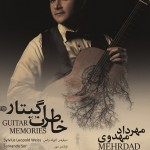
“Guitar Memories” Released
The album “Guitar Memories” consists of the performance of baroque to recent era masterpieces, by Mehrdad Mahdavi, and is published by Tanin-e Honar Publication.
In this album there are pieces composed and arranged by artists such as: Sylvius Leopold Weiss, Johann Anton Logy, Fernando Sor, Yuquijiro Yocoh, Leo Brouwer.

Payam Taghadossi: Talented Iranian-Austrian Cellist
Payam Taghadossi (born in 1989) started his musical education at the age of 4 years with Monika Scherbaum in Bregenz (Austria). At the Conservatory Feldkirch he joined the class of Imke Frank and Martin Merker. Later he studied in Zurich (Switzerland) with Thomas Grossenbacher and Christian Proske, where he 2011 graduated as a Bachelor of Arts in Music Performance. Two years later as the student of Rafael Rosenfeld he received his Master of Arts in Music Performance diploma and later graduated as a Master of Arts in spezialized Music Performance in 2016 from the Hochschule für Musik Basel FHNW.

Harmony in the Iranian Music (II)
One of his works was the translation of Harmony, which was carried out with the help of Mozayyan al-Dowleh, and included a pamphlet based on which he used to teach the subject to the students of the school of music; the pamphlet was never published. It was, in fact, a kind of simple harmony for the piano with no quadriads, it rather featured the engagement of both the right hand and the left hand which was being taught at the music school for the first time. Salar-Mo’azez also composed military marches and hymns for schools, which he harmonized to be performed and piano. Likewise, he used to compose for military orchestras.
Violin’s inner mold, an essential factor in developing the idea of violin
A part of the secrets of the masterpieces from the golden era lies in the special design of the instruments, as a result of a profound insight to and awareness of the significance of the precise calculation of the various components of the object of arts being created, such as making a violin or a bow.

Is the Iranian National Anthem a Copy? (II)
In response, it should be said that it is better for the national anthem of a country to use the musical material exclusive to that country; however, some problems might come up in doing so the most important of which include: lack of familiarity of other countries’ music performer with the concerned country’s specific music intervals and special musical technique; and secondly, the strangeness of that music to the foreign listener.
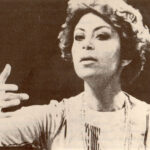
“I Will Never Perform Just for Women!”: Golnoush Khaleghi Passes Away in Exile
Golnoush Khaleghi, first Persian woman conductor and daughter of legendary composer Rouhollah Khaleghi, passed away on February 14. She was 80. Golnoush Khaleghi was the conductor of the NIRT (National Iranian Radio & Television) Choir in the 1970s. Shortly after the 1979 Islamic Revolution Ms. Khaleghi moved to the United States and founded the Rouhollah…
Read More
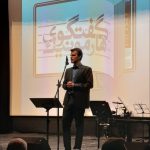
Celebrating 20 Years of Harmony Talk’s Journey: Resilience, Evolution, Honoring the Legacy and Navigating Future Growth
In a momentous celebration of two decades, the “Arasbaran Cultural Center” was the stage for the 20th anniversary of “Harmony Talk”, an online journal that has become a cornerstone in the music community. Sadjad Pourghanad, the editor-in-chief, delivered a speech that resonated with gratitude and vision.
The Structure of Kurdistan Daf (III)
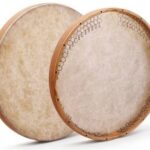
“Our ancestors believe powerful blows upon the Daf scatters evil spirits of disease and distress to create a clean and holy space filled with health and prosperity. Adding tools to Daf increases this instrument’s purification, spreading, and summoning powers of evil forces and goddesses. Daf was mostly depicted by red, color of blood, in ancient times or sometimes it was depicted with green, the color of plants and nature. There were probably some mysterious designs painted upon the wooden body and frames of these instruments just like today” (Pahlavan, 2013: 44).

Developments in Iranian Music Since Qajar Era (II)
Santour:
Nine-bridge and twelve-bridge Sanours were both used until the early Pahlavi dynasty. However, as Faramarz Payvar devised new methods for playing the nine-bridge Sanour, this variety of the instrument which was hammered by felted sticks became popular.
Principles of Violin Playing (IX)
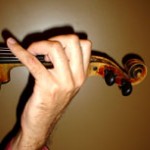
4.3.1. To practice playing of doubles of notes involving two different fingers, each note is played at separate bows with slow tempo, each note is played perfectly regarding its bass and tenor sounds and then the considered double is played at another bow while considering the resulted sound of the double.