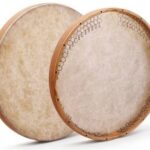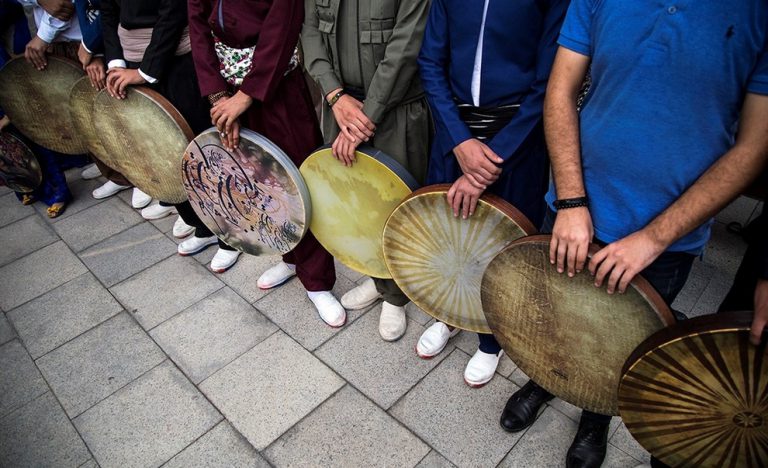
Daf is one of the percussion instruments associated with the Kurdistan region of Iran, which has a special place in Iranian music. In the past, animal skin was used for the drum head, but now most of the tambourines in the market are made with artificial skin, which are designed with various decorations.
A comprehensive study on the decorative motifs recorded on the skin of the tambourine was done in collaboration with two music experts named Sadjad Pourghanad and Pouria Nasiri. The main purpose of this research is to investigate and analyze the methods of using decorative arts on Iranian musical instruments, especially the Daf. In this research, various motifs used on tambourines such as calligraphy, painting, photography and other decorative arts were examined and described.
Based on the classifications, five groups of “painted leather tambourines”, “calligraphic leather tambourines”, “calligraphic artificial leather tambourines”, “painted artificial leather tambourines” and “printed artificial leather tambourines” can be identified. Among the details of the categories of painting, calligraphy and print design, we can mention calligraphy designs, painting designs, graphic designs and photography. In the calligraphy section, the frequent use of Nastalq cursive script cannot be attributed only to its legibility, because other scripts such as Naskh and even Nastalq are more legible. Nastaliq cursive script, along with suspended and Kufi scripts, belongs to those scripts that are very difficult to read. In addition, the use of decorative lines due to their decorative nature and as a result their decorative position on tambourines can affect the popularity of these tambourines to beautify and decorate spaces. In addition, the use of themes familiar to the general public may also serve as evidence of potential public interest in these designs and create additional sales opportunities for producers.
In the painting section, the use of various colors and protective materials to modify the paintings can change the sound of the tambourine, depending on how much they are used. On the one hand, using this art to decorate tambourines may increase the cost of buying these instruments.
Based on the examination of the pictures of music concerts, it seems that these types of tambourines are generally used to decorate various places, similar to a painting, and their concert aspect is not particularly emphasized. Among the types of paintings done, we can mention Iranian paintings using traditional tools as well as realistic paintings.
In the graphic section, we come across a multitude of different designs that have increased over time due to copyright infringement. Due to the ease of printing these images on the synthetic drum shells, it is now possible to customize these designs and attract more people to these types of instruments.
Nowadays, no conservatism can be observed in graphic designs. We see the widespread use of designs unrelated to the musical and cultural tradition of Daf as one of the instruments of classical music as well as in Kurdish ritual and mystical music. However, images related to this tradition and religion still have a stronger presence in the Iranian musical instrument market compared to the aforementioned tambourines.
Among motifs influenced by mysticism, we also come across images such as mandalas and yin-yang symbols, which are only related to Iranian mystical themes. These images indicate the entry of non-Iranian mysticism into Iranian music culture, because even if we assume that these designs are not used in concerts by professional musicians, in the end these instruments are still in demand in Iran and lead to a wide supply. to be “Children’s tambourine” in the graphic section is one of the significant topics in the history of the production of this instrument because not long ago, tambourine students of all ages played with tambourines that had natural skin or simple artificial skin. But today, tambourines with children’s designs are produced in Iran without preserving the thousand-year-old tambourine tradition, and they only satisfy the taste of today’s children in this land.
The photography section in this field shows the diversity and innovation in the design of tambourines. Patterned tambourines, especially those printed on synthetic shells, are presented in a unique way in the market and are recognized as a symbol of contemporary art in Iranian music.
The emergence of new tambourines with images of “women” also reflects cultural and social changes in society. These images, although they may not have a direct connection to the traditional tambourine background, are representations of the role of women in contemporary culture and art. The use of Kurdish women’s faces in traditional costumes not only honors cultural identity, but also promotes contemporary art.
These changes in the design and use of def not only showcase the creativity of contemporary artists, but also emphasize the importance and influence of music in reflecting cultural and social identities.