Transition to Enlightenment: Six Lectures on Mozart’s String Quartets (5)

Lecture 5 & 6: Exploring Mozart’s K. 499 and Prussian Quartets

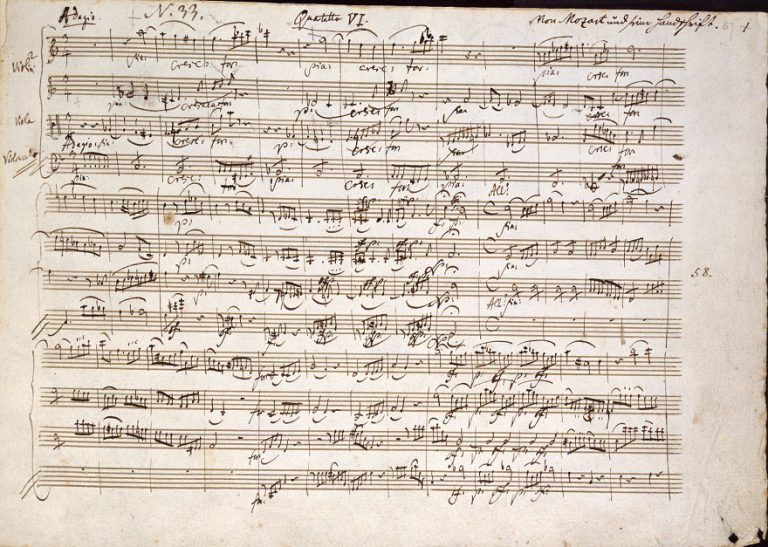
The late 18th century was marked by profound societal changes across Europe, characterized by the rise of the bourgeoisie and the reshaping of musical patronage. Composers like Mozart responded to these shifts by adapting their compositional styles to align with the tastes and sensibilities of the emerging middle class. This article seeks to explore this phenomenon through an analysis of Mozart’s K. 499 quartet, also known as the “Hoffmeister” quartet, and his Prussian quartets, alongside the works of his contemporaries. By examining the evolution of the string quartet genre within the context of changing social structures and aesthetic preferences, this study aims to shed light on the dynamic relationship between music and society.

Evolution of the String Quartet Genre

The string quartet genre underwent a remarkable evolution during the late 18th century, reflecting broader shifts in musical aesthetics, patronage, and societal structures. Emerging from its roots in the Baroque period as a form primarily associated with accompanying vocal music or serving functional roles in courtly settings, the string quartet gradually evolved into a sophisticated and independent genre of chamber music.

At the forefront of this evolution were composers like Franz Joseph Haydn and Wolfgang Amadeus Mozart, who played pivotal roles in establishing the string quartet as a quintessential form of musical expression. Haydn, often referred to as the “Father of the String Quartet,” made significant contributions to the genre through his extensive output of more than 80 string quartets. His works exemplified the Classical style with their balanced structures, thematic development, and inventive use of texture and timbre. Haydn’s quartets served as a foundation upon which subsequent composers would build, providing a model of excellence and innovation.

Mozart, while not as prolific in his output of string quartets as Haydn, made substantial contributions that showcased his mastery of the genre. Works such as his “Haydn” quartets, dedicated to his esteemed colleague, and the “Prussian” quartets composed towards the end of his life, demonstrate Mozart’s ability to infuse the string quartet with emotional depth, lyrical beauty, and contrapuntal complexity. Through his exploration of form and expression, Mozart expanded the boundaries of the genre, paving the way for future generations of composers.

In addition to Haydn and Mozart, other composers of the late 18th century made significant contributions to the evolution of the string quartet genre. Ignaz Pleyel, Franz Anton Hoffmeister, and Paul Wranitzky, among others, added their unique voices to the repertoire, each contributing to the richness and diversity of chamber music during this period. While these composers may not have achieved the same level of renown as Haydn or Mozart, their quartets reflected the stylistic trends and aesthetic preferences of the time, offering valuable insights into the cultural milieu of late 18th-century Europe.

The evolution of the string quartet genre was closely intertwined with broader socio-cultural changes occurring during the late 18th century. As the influence of the bourgeoisie grew and musical patronage shifted from aristocratic courts to private salons and public concert venues, the string quartet emerged as a symbol of cultural refinement and sophistication. Composers, eager to engage with this new audience, adapted their compositional styles to cater to the tastes and sensibilities of the emerging middle class, resulting in a flourishing of chamber music culture.

Overall, the evolution of the string quartet genre during the late 18th century reflects a period of innovation, experimentation, and artistic achievement. Composers like Haydn, Mozart, and their contemporaries pushed the boundaries of the genre, transforming it from a functional ensemble into a vehicle for profound musical expression. As we continue to explore the rich tapestry of Classical chamber music, it is essential to recognize the enduring legacy of these composers and their contributions to the evolution of Western musical culture.

Post a Comment

Required fields are marked *
*
*
Your email is never shared.

Transition to Enlightenment: Six Lectures on Mozart’s String Quartets (5)

The late 18th century was marked by profound societal changes across Europe, characterized by the rise of the bourgeoisie and the reshaping of musical patronage. Composers like Mozart responded to these shifts by adapting their compositional styles to align with the tastes and sensibilities of the emerging middle class. This article seeks to explore this phenomenon through an analysis of Mozart’s K. 499 quartet, also known as the “Hoffmeister” quartet, and his Prussian quartets, alongside the works of his contemporaries. By examining the evolution of the string quartet genre within the context of changing social structures and aesthetic preferences, this study aims to shed light on the dynamic relationship between music and society.

Nasser Masoudi: The Voice of Gilan and a Legacy of Iranian Music

In Iranian music, certain singers have become emblematic of their homelands through their distinctive voices. Historical figures such as Eghbal Sultan, who epitomized the grandeur of Azerbaijani music, and Taj Isfahani, who conveyed the authentic essence of Isfahan, serve as notable examples from the Qajar era. Nasser Masoudi occupies a similar position; his voice emerged as a symbol of Gilan while also achieving national acclaim. Before him, Master Ahmad Ashurpur represented Gilan’s musical landscape, but his extended residence outside Iran limited his continuous engagement in the music scene. In contrast, Masoudi’s consistent presence allowed him to introduce the voice of Gilan to audiences across Iran.

From Past Days…

Developments in Iranian Music Since Qajar Era (I)

At the end of the Qajar era and as Iran entered the power transition period, known as the constitutional era, the Iranian music went through a lot of changes. These changes gained momentum as the students and followers of Ali Naqi Vaziri’s entered the musical scene. These changes greatly influenced designs of instruments, playing methods, singing, composing, etc.

Maestro Hassan Nahid’s Role in Promoting the Ney

Maestro Hassan Nahid is one of the most prominent and distinctive artists who values high morals, discipline and hard work. His music activities include playing the Ney as both soloist and an accompaniment in the most important Iranian music orchestras and ensembles during the last fifty years, including the Orchestra of Iranian Instruments (Nusratullah Golpayegani), the Orchestra of National Instrumentalists of the Ministry of Culture and Arts (Payvar Orchestra), the Orchestra of Iranian Instruments (Morteza Hananeh) , Darvish Orchestra, Samaie Orchestra, Roudaki Orchestra, Maestros’ Ensemble, Aref Ensemble, as well as performances in various radio programs, many concerts in different countries, as well as a long teaching experience in the National Conservatory of Music, music universities and other music institutions to name but a few.

Timeless or Timely: The Role of Historical Context in Defining Artistic Value

Imagine that, in the course of historical research, we discover a musical piece whose compositional techniques (including form, melody, texture, and orchestration) resemble those of a second-rate 19th-century composition. But further investigation reveals that this work predates that period by 200 years. Can we still deem it insignificant? Certainly not. Here, the first major role of historical judgment becomes evident.

Iranian Fallacies – Global Performance

One of the most important criteria for measuring the quality of a piece of classical music is number of times the piece has been performance by different ensembles and orchestras in different eras. This belief has become so pervasive in some societies, such as Iranian society, that it is considered the only criterion for measuring the quality of a piece of classical music.

The Structure of Kurdistan Daf (II)

With its simple physical structure and captivating sound, the Daf never belonged to a particular culture or location, and every nation had different usages for this instrument considering their dominant customs and traditions.

A brief examination of Ardavan Kamkar’s Santour playing style

I still think of those fish in a crystal bowl for the Haft sin table and those disappointed old men who went out to sell blackfish.

The Structure of Kurdistan Daf (VII)

Conclusion

“Daf” is one of type of percussion instruments that has a long history and is commonly known as circular instruments (with a rim). In some tribes, Daf was used as the main instrument in festivity and joy ceremonies; in another tribe it was used as the main instrument for war and campaign ceremonies and some others used it for ritual and religious ceremonies.

Illusion or Ingenuity?

Mohsen Renani in the preface of his book entitled “The Political Economy of nuclear conflict; an introduction to traversing the civilizations” writes:

Non-profit “Microtona” Project Released

Microtona is a sixty-eight-page Booklet with personal comments by the contributing microtonal artists. The booklet also includes a DVD which consists of 8 original video tracks and 9 original audio tracks. The project is an international one featuring unpublished pieces by composers from Iran, Japan, U.S., France, Austria, Germany and Belgium.

Leading the Charge in Censorship

Davoud Pirnia, writer and musicologist was the founder of “Golha” (Flowers of Persian Song and Music) programs on Tehran Radio (1956-1966). He received his early education from his father, Hassan Pirnia (Moshir al-Douleh), and several tutors of the time (Taraghi, interview, July 1989) and continued his studies at Saint Louis School in Tehran and then in Switzerland and graduated in law. While studying law, Pirnia got acquainted with European classical music. Upon returning to Iran, he was employed by the Ministry of Justice and founded the Lawyers’ Guild. Then he was transferred to the Ministry of Finance and established the Department of Statistics in this ministry. Later, he became the head of the state inspection office at the Prime Ministry; he was, then, promoted to the position of the Deputy Prime Minister (Navab Safa, interview, August 1999)